|
Befriending A RefugeThe Archie Carr |
Welcome to the
The Archie Carr National Wildlife Refuge stretches for approximately twenty miles along Florida's central Atlantic coast. The refuge was established in 1990 and was named for the late Dr. Archie F. Carr, Jr., in honor of his contribution to the conservation of natural Florida. Dr. Carr's dedication to the conservation of sea turtles mirrors a principal purpose of the refuge that bears his name.
Carr RefugeClick outlined photos to enjoy an enlargement. Use BACK to return here.

Loggerhead track to sea.
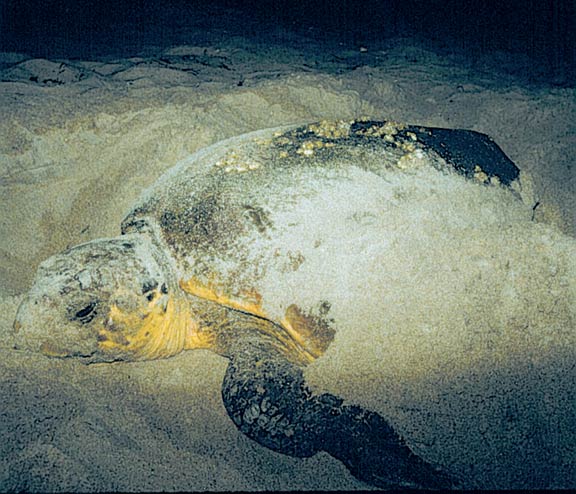
Nesting Loggerhead
Unique Refuge for Sea Turtles
The Carr refuge is the Nation's only refuge designated to protect sea turtles. The site for the refuge was chosen by the turtles themselves. It is the stretch of coast that attracts more sea turtle nesting than any other place in the United States. Five species of sea turtles nest in the Refuge or swim nearby. Each is threatened with extinction.
The Refuge is also unique for its placement within a patchwork of protected lands and among properties that have already been developed. The land on which the refuge sits is as expensive as it is ecologically valuable. The necessity for purchasing and preserving coastal habitats like those of the Carr Refuge is as great as is the challenge of maintaining wild places so close to the influences of human beings.
How Important is this Beach for Sea Turtles?
A nesting green turtle.Of the four species that nest on the beaches of the Carr Refuge, the loggerhead turtle is the most common followed by the green turtle, the leatherback, and the rarest of beach visitors, the hawksbill. Kemp's ridley turtles are known from the waters off the Refuge but have not been recorded nesting. The beach is most special for its importance to loggerheads. Refuge beaches serve as the most densely nested stretch of coast hosting what may be the largest population of loggerheads in the world. The Refuge also sees the greatest number of nesting green turtles in the continental U.S.
Green turtle.
Other Important Natural Features of the Refuge
Indian River Lagoon
& Mullet Creek IslandsCoastal habitats in Florida are increasingly rare. The Carr Refuge serves as a unique preserve of these rare lands at a transition between temperate and tropical habitats. Habitats include maritime hammock, coastal scrub, and the most diverse estuary in the U.S. (the Indian River Lagoon). Rare animals in the refuge include the southeastern beach mouse, West Indian manatee, Florida scrub jay, gopher tortoise, and eastern indigo snake. Numerous wading and shorebird species make the refuge their home and many migratory birds pass through during the spring and fall. The Refuge's Nesting Sea Turtles
While deceptively tranquil during the day, the Refuge beach becomes busy after sundown during the summer nesting season. In late spring, turtles that have migrated hundreds of miles converge off the beach and during a period of months make repeated nocturnal excursions onto the beach to dig nests and lay their eggs. A female sea turtle may nest 2-7 times during a single season, migrate back to her foraging grounds, and not return to the beach again for 2-4 years.
Leatherback hatchling
Loggerhead turtle track, left (wavy center). Green turtle track, right (tail drag).
A loggerhead nest. The track on the left leads away from the borrow pit (shadows on left). Her nest is the mound in the center right that covers her eggs. The tracks on the lower right lead to her nest.
Leatherback track. 6 feet across.
Did You Know...
- Areas in the Carr Refuge average one loggerhead nest for every three feet of beach.
- Sea turtles leave approximately 150,000 pounds of eggs to incubate in Refuge sands every year.
- Few adult sea turtles forage near the nesting beach. Nesting turtles migrate from the Bahamas, the Caribbean, the Florida Keys, and Mexico.
- Sea turtles have outlived the dinosaurs and were around to nest as the first Florida beaches became exposed above the receding seas.
- Outside the Carr Refuge, most of sea turtle nesting in the U.S. occurs on unprotected beaches under private ownership.
Other Rare and Notable Species of the Refuge
Gopher tortoise
A species of special concern
Inhabitant of the Refuge's sandy dune and scrub.Butterfly orchid
A notable Florida native
This orchid clings to the upper branches of large trees in the maritime hammock and can be seen flowering in the spring and summer.Eastern indigo snake
Threatened
A docile snake that grows to 7 feet.Florida scrub jay
Threatened
A bird of open scrub lands that lives in unique family groups.Roseate spoonbill
A species of special concern
Can be found wading the secluded shallows of the Indian River Lagoon.Southeastern beach mouse
Threatened
Lives at the narrow border of sea oats behind the beach.
lingering past dawn on the
Carr Refuge beach.What a Visitor or Resident can do to Help
- Keep artificial lighting off the beach. Lights visible from the beach disrupt nesting and will fatally mislead hatchlings away from the water.
- During the summer, enjoy the beach during the day when you will not disturb the nightly nesting of sea turtles.
- If you are on the beach at night and you encounter a turtle, keep well behind the turtle until she has finished nesting. Closer experiences with sea turtles can be had on guided "turtle walks" that take place on beaches adjacent to the Refuge.
- Park only in designated areas away from fragile dune vegetation.
- Keep your cat indoors. Cats are efficient hunters of the rare small mammals and birds that depend on the Refuge.
- Keep driving speeds at or below posted limits in the Refuge and watch carefully for slow-moving gopher tortoises crossing the road.
- Join the Friends of the Carr Refuge by returning the attached tear out and by making a much needed contribution.
- With your Friends membership you will receive The Carr Companion, a quarterly newsletter describing news and events pertaining to the Carr Refuge and to the critters that live there.
- Friends of the Carr Refuge volunteer their time to remove invasive exotic vegetation, erect educational signs, and participate in refuge cleanups. Friends also serve as the eyes and ears of the refuge managers by taking note of problems within the refuge that need attention.
- Proceeds from membership in Friends will go toward educating visitors to the refuge about the unique part of Florida it protects and toward managing the lands of the refuge to preserve and enhance the natural landscape for both native residents and visitors.
A nesting loggerhead
BACK to Friends of Carr Refuge